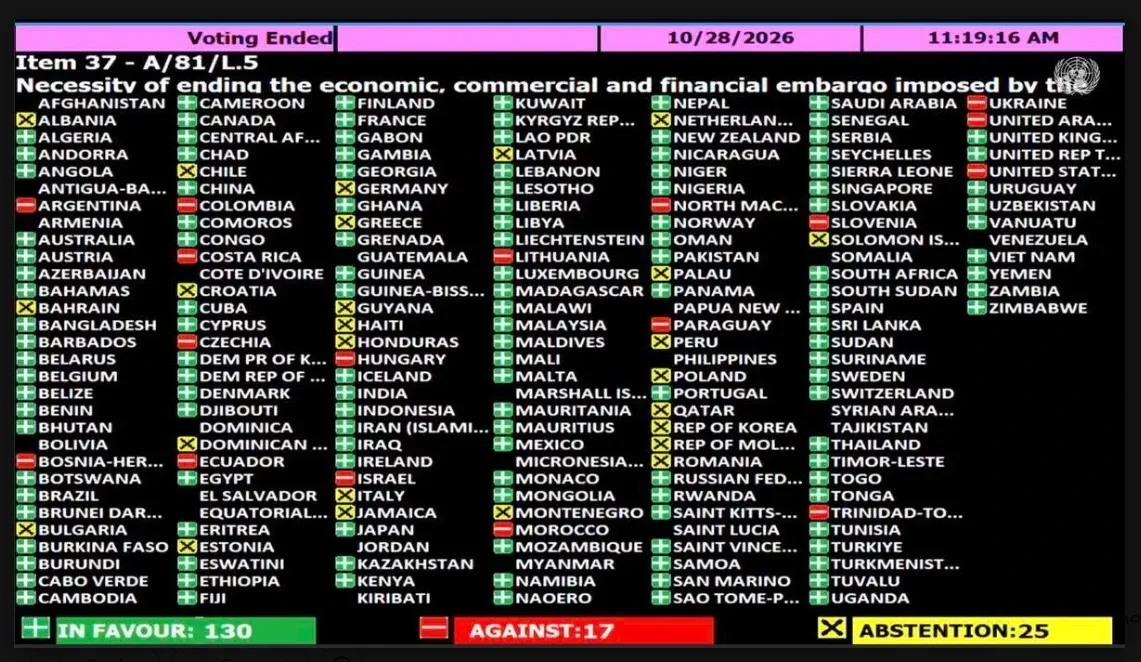
Jamaica abstained for the first time in 34 years and Trinidad and Tobago voted against for the first time ever as the United Nations General Assembly passed its annual resolution calling for an end to the US embargo on Cuba, splitting a Caribbean bloc that has usually voted as one on the issue.
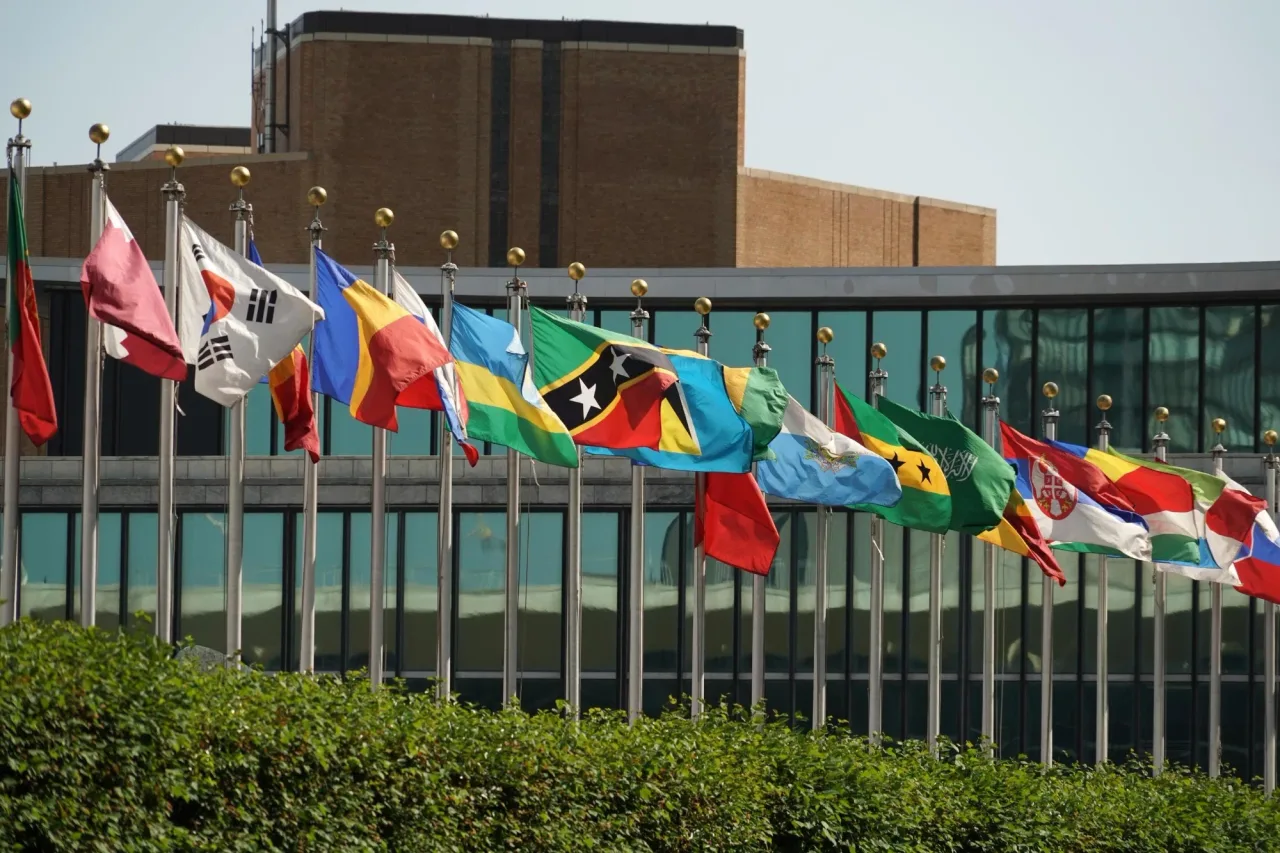
The Assembly voted on Wednesday 28 October by 130 to 17, with 25 abstentions, to adopt the resolution (A/81/L.5), according to the UN meeting record. UN News described it as the weakest backing for the resolution in two decades. Last year it passed by 165 votes to 7, with 12 abstentions.
Within CARICOM, Trinidad and Tobago was the only member to vote no. Jamaica, Guyana and Haiti abstained. The Bahamas, Barbados, Belize, Grenada, St Kitts and Nevis, St Vincent and the Grenadines and Suriname voted yes. Antigua and Barbuda, Dominica and St Lucia did not vote, according to CNC3 and Demerara Waves.
Jamaica: “a shift in policy”
It is the first time Jamaica has abstained on the resolution since it was introduced in 1992, University of the West Indies political analyst Damion Gordon told The Gleaner. Foreign Affairs Minister Kamina Johnson Smith announced the decision at Wednesday’s post-Cabinet press briefing.
“We have been reflecting on this issue for some time, as it is a shift in policy,” she said. Jamaica did not vote no, she said, “because we do not support unilateral action in accordance with the UN Charter”. It did not vote yes because repeating the resolution each year had brought “no improvement in the circumstances, but in fact a deepening of the humanitarian crisis and suffering”. The broader points in Jamaica’s position, including reform in Cuba and talks between Washington and Havana, are “not included in the resolution before the United Nations”, she said, adding that “there is no scope to adjust the language of the resolution”.
Information Minister Dana Morris Dixon said the government had not been pressured by the United States. “There was no one influencing Jamaica. Jamaica is a sovereign nation, and Jamaica made a decision to abstain,” she told journalists.
The day before the vote, Parliament passed without objection a motion on the “economic and humanitarian situation in Cuba”, moved by State Minister Alando Terrelonge. He told the House that Jamaica “could not support a unilaterally imposed blockade”, The Gleaner reported.
The opposition People’s National Party said the two positions were hard to square. “What has changed in the space of 24 hours?” asked its foreign affairs spokesperson, Senator Donna Scott-Mottley, who called on the minister to explain the decision at once and say whether it signals a change in policy, The Gleaner reported.
Gordon said Johnson Smith’s explanation did not justify what he called a “radical” shift, and that the vote was part of a pattern. “It’s a pattern. It’s not a one-off thing,” he said, pointing to Jamaica’s decision in March to end its Cuban medical programme. Havana said at the time that Jamaica had yielded to US pressure. Johnson Smith told a parliamentary committee that the United States played no role, and that the programme ended because the two countries could not agree how the Cuban medical workers would be paid.
Trinidad and Tobago: first “no”
Trinidad and Tobago abstained in 1992 and voted in favour every year from 1993 to 2025, including under Prime Minister Kamla Persad-Bissessar’s 2010–2015 government, the Trinidad Express reported. This year it voted no, alongside the United States and 15 other countries.
In a statement issued on behalf of the United National Congress after the vote, Persad-Bissessar said: “The UNC supports the Cuban people; we do not support a military dictatorship.” She endorsed Secretary of State Marco Rubio’s call for change in Cuba, saying: “for Cuba to prosper, there must be political reforms”, CNC3 reported. The newspaper reported that the US Embassy thanked Trinidad and Tobago for its vote. Foreign Minister Sean Sobers had not publicly explained the vote when the Express and CNC3 reports were published.
Former prime minister Keith Rowley called the vote “so shameful!”, and former foreign minister Amery Browne said it “does not represent the views and ideals of the people of Trinidad and Tobago”. Movement for Social Justice leader David Abdulah said the United States had “managed to divide Caricom very significantly”.
Before the vote, a group of former Caribbean leaders, including Jamaica’s P.J. Patterson and Bruce Golding, signed an open letter urging countries to vote against the embargo, the Rio Times reported. Persad-Bissessar told Guardian Media they should “stop embarrassing themselves with this hypocrisy”.
Washington’s push
US Ambassador Mike Waltz lobbied against the resolution. After the vote he said he was pleased that “so many countries now, including major economies like Korea” had shifted position, Al Jazeera reported. Germany and Italy, which had voted yes last year, abstained, as did Latvia. Cuban Foreign Minister Bruno Rodríguez told the Assembly: “Cuba is not a threat; the blockade is a threat.”
Cuban officials have accused the United States of threatening countries with tariffs and visa restrictions over the vote. JAM has seen no evidence of that for any Caribbean country, and no Caribbean government has said it was pressured.
What people are saying online
The result spread quickly on social media. A post of the results by Kevz Politics on X had about 73,000 views and more than 330 reposts by Thursday morning. A post on JAM Radio’s Threads account had about 18,000 views and 76 replies.
Replies on the JAM Radio thread were largely critical of Trinidad and Tobago and of Jamaica. Many users thanked Barbados, which voted yes. Several asked what an abstention means, and a smaller number defended Trinidad’s vote. These replies are the views of individual users and are not a measure of public opinion.
What an abstention means
Abstaining is not voting against the resolution, and the resolution passed regardless. General Assembly resolutions are not legally binding and do not change US law, but they are widely read as a gauge of international opinion. The US embargo dates from 1960. The Trump administration has more recently moved against countries that supply oil to Cuba, worsening fuel shortages and power cuts on the island, The Gleaner reported.
Guyana and Haiti had not explained their abstentions in the reports reviewed for this story. This story will be updated as governments respond.
Sources used for this report15 verified links
- UN General Assembly meeting record, 28 October 2026
- UN News: Backing for UN call to end Cuba embargo falls to 20-year low
- Al Jazeera: UN votes to condemn embargo of Cuba despite US lobbying push
- The Gleaner: Jamaica abstains from UN vote condemning US embargo against Cuba
- The Gleaner: Jamaica shifts on Cuba
- The Gleaner: Opposition raises concern over Jamaica's abstention
- The Gleaner: Cuba's economic, humanitarian crisis 'deeply troubling' - Terrelonge
- The Gleaner: Cuba says Jamaica yielded to US pressure to withdraw all medical workers
- Trinidad Express: Rowley: T&T's vote against Cuba embargo 'shameful'
- CNC3: T&T turns back on Cuba
- CNC3: PM stands by UN vote, says Cubans deserve democratic freedoms
- Demerara Waves: Guyana abstains from vote on UN resolution condemning US embargo on Cuba
- Rio Times: Jamaica ex-PMs urge UN vote on Cuba embargo
- Caribbean National Weekly: Trinidad PM accuses former CARICOM leaders of hypocrisy
- JAM Radio on Threads: UN vote result post