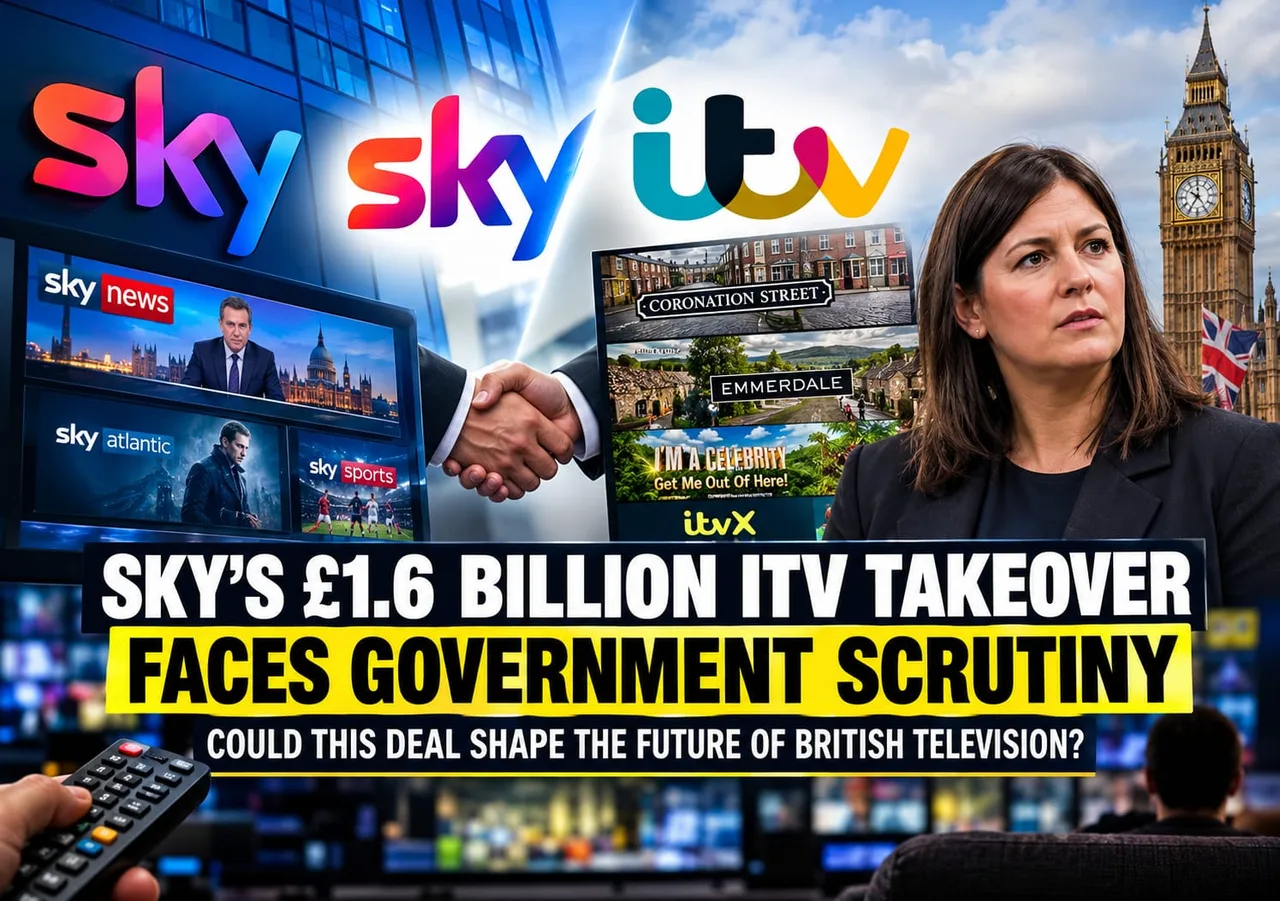
Britain’s television industry could be approaching a major turning point as the Government raises concerns over Sky’s proposed £1.6 billion acquisition of ITV’s broadcasting and streaming business.
The proposed deal could reshape the future of British television, placing some of the country’s best-known channels and streaming services under the ownership of one of the UK’s biggest media companies.
On Thursday, 15 October, Culture Secretary Lisa Nandy announced that the Government was minded to intervene in the proposed transaction, citing concerns about media ownership, the diversity of news coverage and the range of programming available to audiences.
The development raises an important question for millions of viewers: could this deal strengthen British television for the future, or risk placing too much influence over what the nation watches in the hands of fewer companies?
Sky and ITV have until 9am on Tuesday, 20 October, to respond to the Government’s concerns. No final decision has been made on whether formal intervention will proceed.
Why does the Sky–ITV deal matter?
For millions of people across the UK, ITV is more than a television channel. It is home to some of Britain’s most recognisable programmes, including Coronation Street, Emmerdale and I'm a Celebrity... Get Me Out of Here!
The broadcaster also provides national and regional news, entertainment programmes, reality television and ITVX, its free streaming platform, which allows viewers to watch programmes on demand.
Sky, meanwhile, operates a major pay-TV business, entertainment channels and Sky News.
If the acquisition proceeds, Sky would gain control of ITV’s broadcasting channels and streaming service, bringing two significant players in British television under the same corporate ownership.
However, the proposed transaction does not include ITV Studios, the production business responsible for making programmes for British and international audiences.
That distinction is important. The deal concerns ITV’s broadcasting and streaming operations rather than the entire ITV business.
The Government’s biggest concern: could viewers lose choice?
At the centre of the Government’s concerns is the question of media plurality — the principle that audiences should have access to different news sources, viewpoints and forms of programming rather than relying on a small number of powerful organisations.
The Government wants to examine whether the proposed acquisition could affect the diversity of news provision, freedom of expression and the range of quality programmes available to the British public.
There is also a wider debate about how broadcasting rules should apply as more people move away from traditional television towards streaming services.
For years, British broadcasters have operated under rules designed to protect audiences and maintain public-service broadcasting standards. However, viewing habits have changed dramatically, with platforms such as Netflix and Disney+ becoming increasingly influential.
This raises questions about whether existing safeguards are sufficient in an entertainment market where traditional broadcasters compete with global streaming companies.
The Government’s concerns do not mean that a reduction in choice has already been established. Rather, the potential consequences of the proposed deal are being examined before a decision is made.
For viewers, the central issue is whether the acquisition would create a stronger competitor in the global entertainment market without undermining the diversity that has helped shape British television.
What does Sky say about the takeover?
Sky has defended the proposed acquisition, arguing that bringing its business together with ITV’s broadcasting and streaming operations could create a stronger British media company capable of competing with international streaming giants.
The entertainment industry has undergone significant change as audiences increasingly choose on-demand services over scheduled television.
Traditional broadcasters must now compete for viewers, advertising revenue and investment while maintaining the quality of their programming.
Sky believes the proposed transaction could strengthen its ability to invest in British content, support trusted journalism and compete more effectively in a rapidly changing media landscape.
The companies have also indicated that ITV’s free-to-air services would be protected under their plans, alongside commitments concerning public-service broadcasting and the distinct editorial identities of ITV News and Sky News.
However, assurances from the companies will need to be considered alongside the Government’s concerns about media ownership and the potential effect on audiences.
The challenge is to establish whether the benefits promised by the deal outweigh any risks associated with concentrating ownership.
Could Coronation Street and Emmerdale be affected?
For loyal viewers, one of the most immediate questions is what the proposed acquisition could mean for their favourite programmes.
ITV has played a major role in British popular culture for decades, with Coronation Street and Emmerdale becoming familiar fixtures in households across the country.
At present, there is no confirmed announcement that either programme will be cancelled or removed from free-to-air television as a result of the proposed takeover.
Sky and ITV have said they intend to protect ITV’s free-to-air services.
Nevertheless, a change in ownership can raise longer-term questions about investment, commissioning decisions, scheduling and the balance between mainstream entertainment and programmes serving more specialised audiences.
There are also questions about regional television. Local news services provide coverage of community issues, council decisions, public services, local businesses and events that might otherwise receive little national attention.
Any future changes to funding or programming priorities could therefore have implications beyond entertainment, particularly for audiences who rely on regional broadcasters for information about their communities.
These are potential issues for consideration, not confirmed outcomes of the proposed deal.
A bigger battle for the future of British television
The proposed acquisition comes at a time when traditional broadcasters face growing competition from streaming platforms, online video services and digital creators.
Younger audiences increasingly consume entertainment through smartphones and social media, while established television companies are under pressure to find new ways to attract viewers.
Supporters of the takeover argue that British broadcasters need greater financial strength and scale to compete internationally. A larger business could potentially invest in new programmes, improve streaming services and reach audiences beyond the UK.
However, critics of media concentration may question whether bringing major broadcasting operations under common ownership could reduce competition or limit the range of voices available to audiences.
Both arguments deserve consideration.
A stronger broadcaster could have greater resources to invest in British entertainment, but the concentration of ownership also makes it important to examine who controls programming decisions, how editorial independence is protected and whether viewers continue to have meaningful choices.
The Government’s scrutiny is therefore about more than a £1.6 billion business transaction. It touches on the future of public-service broadcasting, the availability of British-made content and the role of independent news providers in a democratic society.
Sky and ITV must respond to the Culture Secretary’s concerns by 9am on 20 October 2026.
If the Government proceeds with a formal public-interest intervention, Ofcom would assess the relevant public-interest issues, while the Competition and Markets Authority could examine competition concerns under the applicable regulatory process.
Further investigation may follow, depending on the findings and subsequent decisions.
The proposed acquisition has not received final regulatory clearance, and its eventual outcome remains uncertain.
For viewers, the questions are straightforward but significant. Will the deal give British television the strength it needs to compete with global streaming giants? Could it lead to greater investment in home-grown entertainment? And what safeguards will ensure that a wider range of voices and programmes remains available?
The answers could help shape the television landscape experienced by millions of households across the UK for years to come.
The final word
This is not simply a corporate takeover. It is a debate about media power, public choice and the future of British entertainment.
For some, the proposed deal represents an opportunity to build a stronger competitor in an increasingly international industry. For others, it raises important questions about how much influence any single company should have over the news and entertainment audiences consume.
Neither the benefits nor the potential risks should be taken for granted. The regulatory process will be crucial in determining whether the transaction can proceed and under what conditions.
JAM Radio UK will continue to follow developments in British entertainment, broadcasting and culture as the future of the Sky–ITV deal unfolds.
What do you think? Would a stronger British broadcaster help protect the future of UK television, or should greater emphasis be placed on preserving competition and keeping media ownership diverse?