Published 90 views
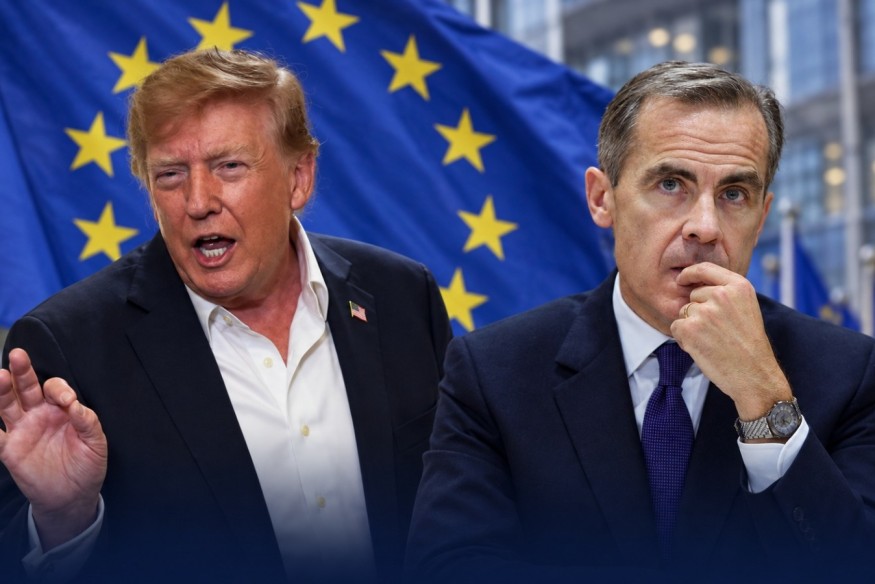
The US president branded closer Canadian ties with Europe “laughable”, while Mark Carney argued that the two sides must work together to protect their economies and sovereignty.

Donald Trump has threatened to impose heavy tariffs on the European Union—or stop trading with Europe in some areas—if he decides that its proposed new alliance with Canada represents a hostile act against the United States.
The US president issued the warning after European Commission President Ursula von der Leyen proposed making Canada the EU’s first “associate member”, opening the door to a much deeper economic, political and security relationship.
Advertisement
Collect AKIMYAX Anime Keyrings
Meet Nori & Miko — the first original duo from the AKIMYAX Pocket Duo Series.
SHOP AKIMYAXTrump dismissed the proposal as “laughable” and described Canada as a poor trading partner.
“If I think it’s at all a hostile act, I will put very serious tariffs or stop trading with Europe on many things,” he told reporters.
President Trump says he would impose "serious tarriffs" on the European Union if Canada becomes the bloc's first "associate member".
— Channel 4 News (@Channel4News) September 17, 2026
The European Commission President, Ursula von der Leyen, told European Parliament on Wednesday that she wanted to "open the door" to closer ties… pic.twitter.com/UvGOzhNXAL
Canada looks beyond Washington
Trump’s intervention comes as Canadian Prime Minister Mark Carney attempts to reduce his country’s heavy economic dependence on the United States.
Canada is not seeking full membership of the European Union. Instead, Carney wants what he has called a “unique alliance” extending far beyond the existing Canada–EU trade agreement.
The proposed partnership could include closer cooperation on critical minerals, defence production, artificial intelligence, energy security, space technology, digital trade, financial services and secure communications.
Its precise structure has not yet been decided. “Associate membership” does not currently exist as a formal status under EU treaties and any final arrangement would require further negotiations and political approval.
Nevertheless, the proposal signals a significant shift in Canada’s economic direction as relations with Washington deteriorate.
Trump’s tariffs, demands for economic concessions and repeated pressure on Canada have accelerated Ottawa’s search for dependable partners beyond the United States.
Carney rejects the idea of a rival bloc
Addressing the European Parliament in Strasbourg, Carney welcomed the EU’s ambition and declared that “Europe and Canada are even stronger together”.
He insisted that the proposed alliance was not intended to create another superpower competing for global dominance.
“I am not proposing a third bloc in order to become a great-power rival—only with better manners,” Carney said.
Instead, he argued that Canada and Europe must build enough collective resilience to prevent any outside power from controlling their markets, weakening their sovereignty or dictating their political choices.
Canadian Prime Minister Mark Carney welcomed the proposal to become an "associate member" of the European Union.
— Channel 4 News (@Channel4News) September 17, 2026
Carney said a deeper alliance between Canada and the EU would create a “beacon for other democracies” during a speech to the European Parliament in Strasbourg.
On… pic.twitter.com/02fHWiK4yT
Carney’s language appeared carefully designed to avoid naming Trump directly while responding to the pressure coming from Washington.
He presented the proposed alliance as protection against economic coercion rather than an attack on the United States.
The European Commission delivered a similar response, saying that closer cooperation with Canada was “not against anyone else” but intended to strengthen both partners.
Trump widens the dispute
Trump’s threat potentially transforms what began as a dispute between the United States and Canada into a much wider confrontation with Europe.
The EU has already endured repeated pressure from Washington over trade, defence expenditure and foreign policy. The possibility of additional tariffs now places its relationship with Canada at the centre of those tensions.
Advertisement
Collect AKIMYAX Anime Keyrings
Meet Nori & Miko — the first original duo from the AKIMYAX Pocket Duo Series.
SHOP AKIMYAXHowever, threatening Europe for negotiating independently with Canada may strengthen the argument Carney is making.
Canada built much of its modern economy around access to the American market. That dependence becomes a vulnerability when trade access can be withdrawn or restricted as a means of political pressure.
Carney is now arguing that Canada requires additional markets, stronger alliances and greater control over its economic future.
Trump may have intended his warning to discourage Europe from proceeding. Instead, it could reinforce the belief in both Canada and the EU that they need alternatives to an increasingly unpredictable United States.
The question is no longer simply whether Canada can secure a new agreement with Europe.
It is whether Trump’s threats are actively pushing America’s closest allies into building a future that depends less upon Washington.