August 03, 2026 - 1472 views
Image by Jacqueline Mckenzie
“We Will Fight for Reparations — But We Will Not Wait”: Dr Umar Johnson Calls for Global Black Organisation in Brixton
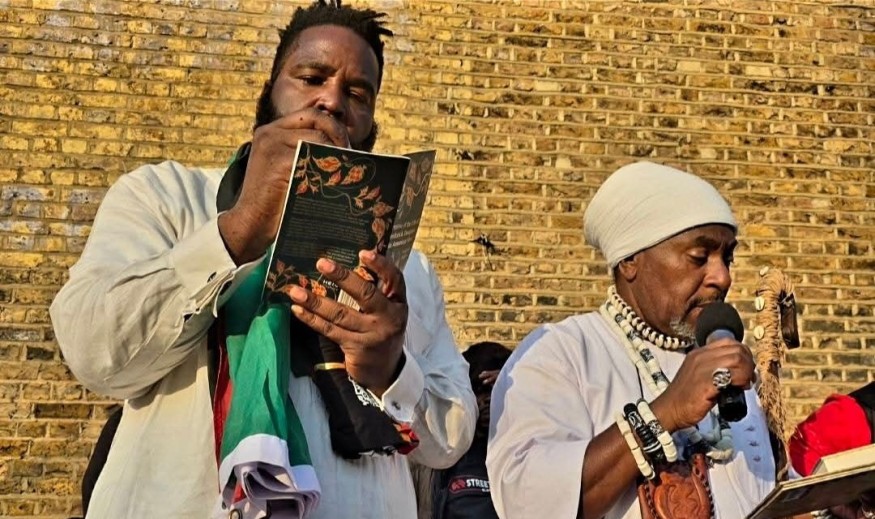
The Pan-African speaker used his keynote address at Brixton’s Afrikan Reparations Day rally to urge African-descended communities to organise across borders, finance their own institutions and pursue liberation without waiting for governments to deliver justice.
“We will fight for reparations — but we will not wait.”
It was the declaration that defined Dr Umar Johnson’s keynote address in Brixton: reparations must continue to be pursued, but the global African diaspora cannot postpone the work of building its own power while waiting for former colonial and slaveholding nations to respond.
Advertisement

Speaking at the Afrikan Reparations Day March and Rally in Windrush Square, referred to by organisers as Afrikan Pioneer Square, on Saturday, 1 August, Johnson delivered a forceful call for Black communities across Europe, the Caribbean, Africa and the Americas to move beyond speeches, social-media posts and symbolic solidarity.
His central argument was that the campaign for reparatory justice must be accompanied by organisation, cooperation and collective investment.
“Brothers and sisters of England, brothers and sisters of Europe, we have to finance our liberation,” he told the gathering.
“We will fight for reparations — but we will not wait.”
— Jam Radio UK News (@Jam_RadioUK) August 3, 2026
Dr Umar Johnson delivers a powerful message in Brixton, calling for Black unity, global organisation and investment in our own liberation.
Watch the keynote address. #UmarJohnson #Reparations #Brixton
video: by J.… pic.twitter.com/WkswVJ2Yxt
Video by Jacqueline Mckenzie
“Yes, we’re fighting for reparations, but we cannot wait to get them. We will continue to fight for reparations — hard — but we will not wait.”
Advertisement
Collect Akimyax Anime Keyrings
Johnson called for a more organised relationship between African-descended communities around the world, including Black communities in Europe, Canada, the United States, Mexico, Brazil and the Caribbean.
He urged activists to begin holding conferences that would connect those communities and allow them to develop a common strategy.
“Most of you here, just like me, we are the children of the transatlantic slave trade,” he said.
“We are the descendants of the Maafa. We are the ones who have inherited the pain, the legacy, the prophecy and the destiny of our ancestors.”
Advertisement

His message was that a shared history must become the foundation for coordinated action.
“Let us do the work of organisation,” Johnson said. “Let us do the work of reparations. Let us do the work of liberation.”
The address came at a significant moment for the international reparations movement. Johnson referred to the African Union’s declaration of a decade devoted to justice and reparations for Africans and people of African descent.
He also highlighted Ghana’s role in securing a landmark United Nations General Assembly resolution in March 2026.
Advertisement

The resolution described the trafficking and racialised chattel enslavement of Africans as the “gravest crime against humanity”. It was adopted with 123 countries voting in favour, three voting against and 52 abstaining.
“We have to finance our liberation”
While Johnson supported demands for reparations from governments and institutions that benefited from slavery and colonialism, he challenged Black communities not to make their progress entirely dependent on those demands being met.
“Let’s use our money now,” he said. “Let’s use our resources now. Let’s use our time now. Let’s use our intelligence now.”
His argument effectively shifted part of the responsibility back onto the diaspora: what institutions could be built, what organisations could be strengthened and what political power could be developed using the resources already available?
Johnson warned that while campaigners waited, external powers were continuing to consolidate their influence across Africa and the Caribbean.
Advertisement

“We will fight for reparations, but we will not wait,” he repeated.
The speech also contained a direct criticism of activism that never moves beyond public commentary.
“We just can’t tweet about it,” Johnson said. “We just can’t Facebook about it. We just can’t Instagram about it. We just can’t TikTok about it.”
“We’ve got to organise about it. We have to plan about it. We have to meet about it. We have to finance it.”
A challenge directed inwards
Some of the most striking passages were not directed at governments, former colonial powers or white institutions. They were directed at divisions within Black political movements themselves.
Johnson appealed for greater compassion, humility and forgiveness between people working towards the same broad objectives.
“Some of us are so filled with hate for the white man that we don’t have any love for the Black man,” he said.
“What good is a Negro who hates his enemy and also hates his brethren?”
He continued:
“If you cannot forgive, you are not a revolutionary. You’ve got to be able to overlook the faults of your brother and of your sister.”
Johnson called on those present to see the African diaspora as a single body, arguing that homelessness, hunger and suffering experienced by one section of the community should be understood as a collective concern.
Advertisement
“If I hurt, you hurt,” he said. “If you hurt, I hurt. If you’re hungry, I’m hungry. If you’re homeless, I’m homeless.”
That appeal to compassion sat alongside some of the speech’s more confrontational language, illustrating the mixture of solidarity, nationalism and provocation for which Johnson has become known.
“Racism is not the biggest problem”
Johnson also made one of the most challenging statements of the address when he told the audience:
“Racism is not the biggest problem. It only looks like it’s the biggest problem because we are not united.”
In context, he appeared not to be denying the existence or effects of racism, but arguing that division leaves Black communities less able to confront it.
“This world cannot stop a united African people,” he said. “This world cannot stop a serious African people. This world cannot stop a dedicated African people.”
It was an attempt to move the focus from what oppressive systems were doing to Black people towards what Black communities were prepared to build and defend collectively.
Controversial remarks about ADHD
The speech was not without controversy.
During an earlier passage, Johnson urged Black parents to keep their children away from medications including Ritalin and Adderall. He then claimed:
“Your son don’t have ADHD. He just ain’t got no daddy at home.”
The sweeping claim is not supported by established medical understanding of ADHD, which recognises it as a condition affecting how the brain functions.
Advertisement
Medication is neither necessary nor appropriate for every child, but treatment decisions should be made according to the child’s individual circumstances and in consultation with qualified medical professionals.
Johnson’s remarks are therefore likely to concern parents, clinicians and advocates who have campaigned for better recognition of ADHD within Black communities.
From compassion to militant rhetoric
Towards the end of the address, Johnson invoked the legacy of Harriet Tubman and the Underground Railroad, presenting her as an example of determination in the face of fear and oppression.
His closing language then became markedly more militant.
“I believe the next war will be a war to free Africa,” he said.
He told the gathering that he believed Black people would one day be called upon to reclaim Africa and concluded with the Pan-African declaration:
“One God, one aim, one destiny.”
Johnson also paid tribute to the people responsible for organising the Brixton gathering, reminding the audience that events lasting several hours could require months of planning, sacrifice and largely unseen work.
A demand — and a challenge
Johnson’s Brixton speech moved between a number of different messages: reparations and self-reliance, international solidarity and internal forgiveness, compassion between Black people and militant warnings about Africa’s future.
Not every statement will attract agreement. Some, particularly his comments about ADHD and medication, require firm scrutiny. Others will provoke debate about where Pan-African solidarity ends and polarising rhetoric begins.
But the central political challenge he placed before the gathering was unmistakable.
Reparations, in Johnson’s argument, must remain an international demand — but liberation cannot be placed on hold until reparations arrive.
“Let us do the work of organisation. Let us do the work of reparations. Let us do the work of liberation.”
Black communities, he said, must organise, cooperate and invest in themselves now.