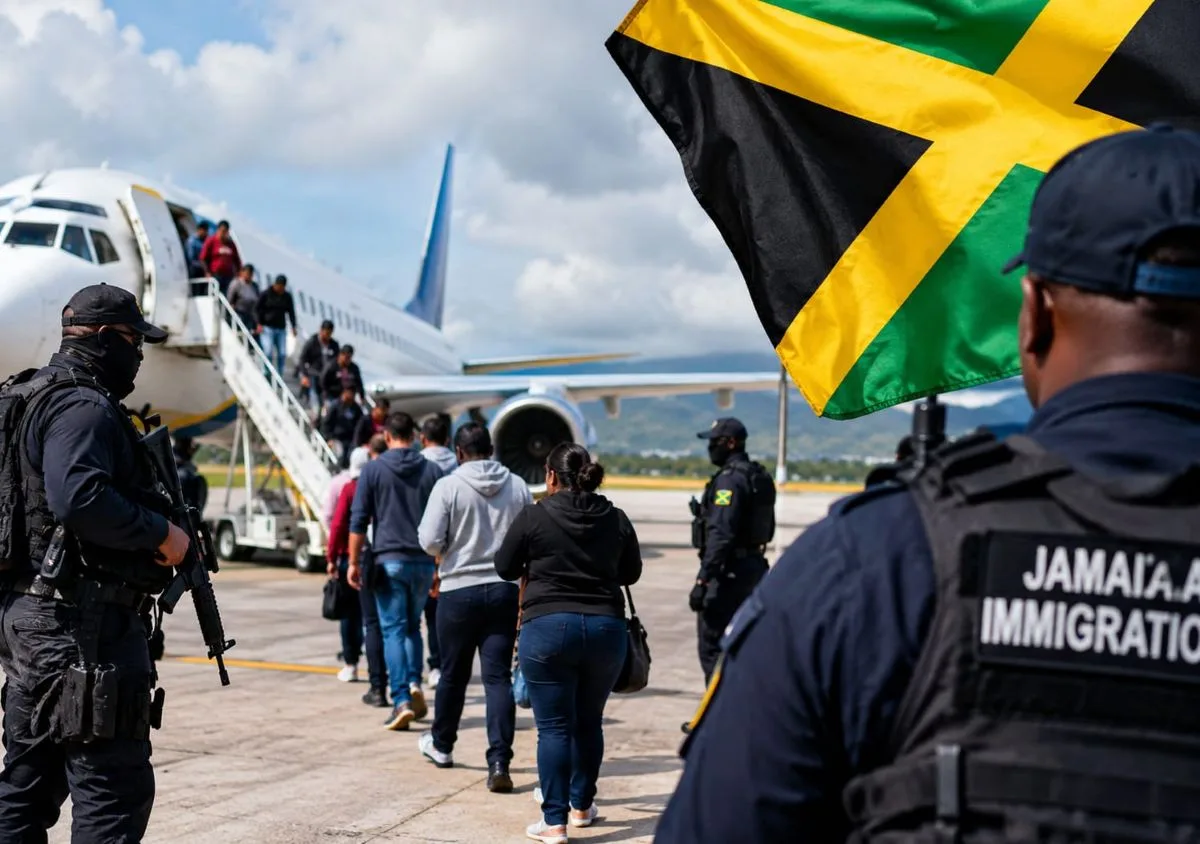

Jamaica has officially begun accepting migrants deported from the United States under a controversial new agreement, placing the island at the centre of an international debate over migration, transparency and national sovereignty.
The first group arrived at Norman Manley International Airport in Kingston on Tuesday, 13 October, marking the start of a programme that allows certain non-Jamaican nationals removed from the United States to be temporarily transferred through Jamaica before continuing to their final destinations.
According to reporting by the Associated Press, 22 adults, including seven women, arrived on the inaugural flight. After being processed by authorities, the migrants were transported under police escort to an undisclosed location. Media access to the arrival was restricted, adding to growing public interest and political scrutiny surrounding the arrangement.
The agreement stems from a memorandum of understanding signed between Jamaica and the United States in June 2026. Under the deal, migrants from countries other than Jamaica may be temporarily housed on the island while arrangements are made for their return to their home countries or transfer to another receiving nation.
Government officials have stated that the programme will be limited to a maximum of 25 people every two weeks and will operate with logistical support from the International Organization for Migration (IOM) through its Assisted Voluntary Return programme. Jamaican authorities have also stressed that taxpayers will not fund the initiative and that individuals with criminal records will not be accepted under the arrangement.
While officials describe the programme as a controlled and humanitarian process designed to facilitate safe and orderly returns, the lack of public information about the agreement has fuelled concerns among opposition politicians, advocacy groups and members of the public.
Critics argue that Jamaicans are being asked to accept a significant international commitment without seeing the full details of the memorandum governing it. Questions have been raised about transparency, national security, legal accountability and the potential long-term implications for the country.
Opposition figures, including National Security spokesperson Fitz Jackson and Opposition Leader Mark Golding, have called for greater disclosure about what Jamaica has agreed to, what safeguards exist for the public and what benefits, if any, the country will receive in return.
Some critics have also questioned why migrants cannot be sent directly from the United States to their home countries instead of being routed through Jamaica, a concern that has become more prominent now that flights have commenced.
Foreign Affairs Minister Kamina Johnson Smith has defended the agreement, maintaining that Jamaica negotiated the arrangement with the country's interests and security considerations firmly in mind. Government ministries have reiterated that the programme is intended solely to support migrants' onward journeys and that international organisations will play a key role in managing the process.
However, officials have also acknowledged that the United States has not authorised the public release of the memorandum, a reality that continues to intensify calls for transparency.
The development comes against the backdrop of a broader United States strategy involving third-country deportation arrangements. Similar agreements have emerged involving countries such as Liberia, Eswatini and Paraguay, prompting international debate over migrant rights, due process protections and the legality of removing individuals to countries with which they have no direct connection.
For Jamaica, the arrival of the first deportees transforms what was once a largely diplomatic agreement into a real-world test of policy, governance and public trust.
As flights continue and public scrutiny grows, many Jamaicans will be watching closely for answers to key questions: Where will migrants stay? How long will they remain on the island? What oversight mechanisms are in place? And how will the government ensure that Jamaica's interests remain protected?
Those questions may ultimately determine whether the programme is viewed as a responsible international partnership or a controversial arrangement that has raised more concerns than it has resolved.