August 11, 2026 - 1106 views
Photo credit: Associated Press
Donald Trump was secretly moved to another aircraft after a reported Iranian missile threat, while journalists and White House staff continued aboard the presidential jet used as a decoy—raising questions about their safety, presidential courage and who carries the human cost of war.

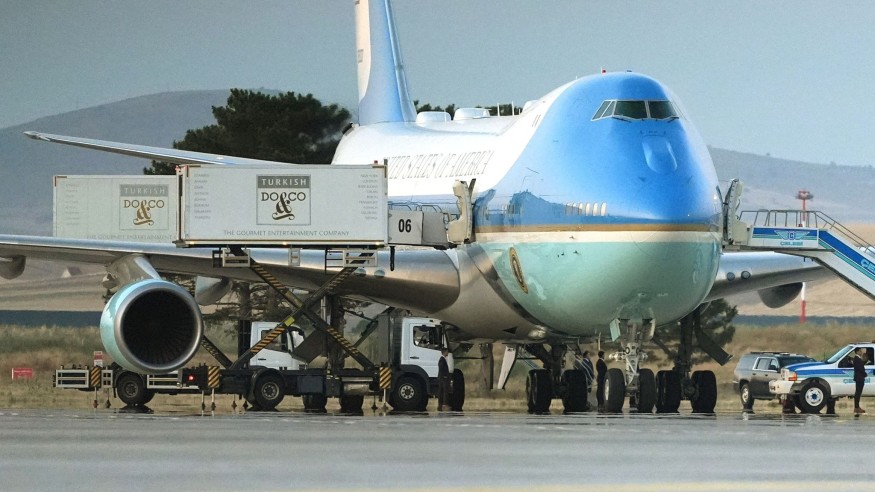
Donald Trump climbed the steps of the familiar blue-and-white presidential aircraft in full view of television cameras as he prepared to leave Turkey following the NATO summit. But the president did not remain aboard.
According to an investigation by The Washington Post, Trump and several aides were secretly removed through a door on the opposite side of the aircraft, lowered into an airport catering vehicle and driven across the tarmac to a smaller Air Force C-32A.
Trump then flew discreetly to Britain aboard that aircraft while journalists and some White House employees continued their journey aboard the presidential Boeing 747 believing he was still travelling with them.
Advertisement
Collect Akimyax Anime Keyrings
The extraordinary operation was reportedly ordered after US intelligence detected what officials considered a credible Iranian or Iran-backed plot to fire a missile at the aircraft carrying Trump as it departed Ankara.
No missile was launched, and important details remain secret. The identities of the suspected attackers, the proposed launch location, the type of weapon involved and how close the alleged plot came to being carried out have not been publicly disclosed.
Advertisement

An occupied decoy—not an empty aircraft
The most troubling aspect of the operation is not that the Secret Service protected the president. Protecting the head of state and ensuring the continuity of government are legitimate national-security responsibilities.
Leaving Trump aboard an aircraft believed to be the target of a possible missile attack would not have demonstrated responsible courage. It would also have endangered the pilots, cabin crew, Secret Service officers, military personnel and advisers travelling with him.
The issue is that the aircraft used to maintain the appearance that Trump remained aboard was not empty.
Journalists and White House staff were allowed to fly on the large and highly recognisable presidential jet while apparently unaware that Trump had changed aircraft or that they had become part of an elaborate deception operation.
Advertisement
Reporters were reportedly instructed to keep their window shades closed. The aircraft continued to present itself visually as the plane carrying the president, while Trump’s real location was concealed aboard the smaller C-32A.
That meant the occupied Boeing 747 continued to look like the obvious presidential target.
It cannot presently be proved that the journalists and staff were placed at greater overall risk. The older presidential aircraft possesses sophisticated missile-warning systems and defensive countermeasures, and creating uncertainty about Trump’s location may have reduced the chances of any attacker successfully targeting him.
There is also no evidence that security officials intended to sacrifice the passengers or deliberately use them as human shields.
Nevertheless, the people aboard were unknowingly made part of a deception designed to draw attention away from Trump’s true location. Had an attacker relied on the visible aircraft and fired upon it, everyone aboard—including journalists, employees, pilots and military crew—could have been killed or seriously injured.
The difficult question is therefore not simply whether the decoy operation protected the president. It is whether it was necessary or acceptable to operate that decoy with uninformed passengers still aboard.
Advertisement

Trump’s disturbing joke to the reporters
Before the flight, Trump publicly claimed that he was using the older presidential aircraft “for old time’s sake” and so that American service personnel stationed in Britain could see it.
That explanation now appears to have formed part of the cover story surrounding the operation.
After arriving at RAF Mildenhall, Trump was reportedly placed back aboard the larger presidential aircraft so that he could publicly descend its steps in front of the cameras, maintaining the appearance that he had travelled aboard it from Turkey.
Later, reporters questioned why they had been instructed to keep their window shades closed during the journey.
Trump reportedly told them that they had probably been on a “dangerous flight” before joking:
“But if I go, you go. Right?”
Except Trump had not gone with them.
While the reporters believed they had shared the danger with the president, Trump had travelled separately aboard an aircraft whose movements and passenger list were concealed.
His comment therefore appears very different in light of what is now known.
What may initially have sounded like gallows humour shared among people facing the same threat now appears to have been a joke directed at people who unknowingly formed part of the plan protecting him.
They had flown aboard the aircraft presented as carrying the intended target. Trump had not.
Advertisement

Protection is not cowardice—but leadership requires accountability
A president following professional security advice should not automatically be accused of cowardice.
Remaining aboard an aircraft believed to be the subject of a missile plot would not have been an act of responsible bravery. It could have endangered the president, the crew, the Secret Service and the stability of the United States government.
Presidential deception and decoy operations are also not entirely unprecedented. Other presidents have travelled aboard alternative aircraft during high-risk journeys while more recognisable planes were used to create uncertainty about their location.
But the moral question in Trump’s case is more complicated.
The potential cowardice does not lie in accepting protection. It lies in creating the public appearance that the president was sharing a danger that was, in reality, being carried by people who did not know they were aboard the decoy.
Advertisement
Trump has built much of his political identity around personal strength, toughness, aggression and fearlessness. He regularly presents himself as a leader who refuses to retreat or be intimidated.
That image deserves to be examined against what happened when the consequences of his own foreign policy appeared to reach him personally.
Courage in political leadership is not demonstrated by unnecessarily remaining in the path of a missile. It is demonstrated through honesty, accountability and a willingness to confront the consequences of decisions imposed upon others.
The war Trump ordered has already killed Americans
The reported assassination threat did not emerge in a political vacuum.
Trump gave final approval for a major American military operation against Iran, joining Israel in a war that has already killed American service personnel, wounded hundreds more, cost US taxpayers tens of billions of dollars and killed thousands of Iranians.
At least 18 American service members have reportedly been killed in the conflict. Some were returned to the United States in flag-draped transfer cases as their families confronted the consequences of decisions made in Washington.
The contrast is impossible to ignore.
The commander-in-chief who approved the military operation was extracted through a carefully planned deception when the personal consequences of the conflict appeared to reach him.
The servicemen and women carrying out his orders do not have catering vehicles, secret aircraft, alternative call signs and occupied decoys available when missiles and drones reach their bases.
Their families cannot transfer the danger to somebody else.
That does not mean Trump should have refused protection. It means that his displays of aggression and personal toughness must be judged against the unequal way in which the dangers of war are distributed.
Political leaders order wars. Soldiers, military families, civilians, journalists and ordinary workers frequently carry the consequences.
The most heavily protected person in the conflict is also the person exercising the greatest power over whether it continues.
Questions surrounding the Qatari aircraft
The incident has also reopened questions about Trump’s controversial Qatari-donated Boeing 747-8, which had recently entered presidential service.
Reports had previously raised concerns about whether the newer aircraft possessed the same extensive defensive countermeasures and communications systems installed aboard the older presidential jets.
The administration has maintained that the aircraft met the required security standards. However, the reported Iranian threat led to an unusually complicated return operation involving the Qatari aircraft, the older presidential Boeing 747 and the smaller C-32A that secretly carried Trump.
That raises an additional question: did the rush to place the Qatari aircraft into presidential service create further security complications?
Advertisement
The controversy extends beyond the aircraft itself.
The administration reportedly sought subpoenas against journalists in an effort to identify confidential sources behind reporting about the plane’s security limitations. Those demands were later withdrawn after officials acknowledged problems with how the matter had been handled.
The combination of a controversial presidential aircraft, a reported missile threat, an occupied decoy and efforts to investigate journalists’ sources raises broader concerns about secrecy and accountability inside the administration.
Advertisement
The White House still owes answers
The White House has not directly addressed the central allegation that journalists and staff were unknowingly carried aboard the decoy.
Officials have instead referred generally to the many threats facing Trump and the government’s responsibility to use every available tool to protect the president.
The Secret Service and Pentagon have also declined to provide a detailed public explanation of the operation.
There is no public evidence that Trump personally designed the decoy plan or decided that journalists and staff should remain aboard the other aircraft. Those operational decisions were probably made by military and security officials responding rapidly to intelligence about a possible assassination attempt.
But the administration remains accountable for what happened.
Congress and the public are entitled to ask who authorised an occupied aircraft to operate as the apparent presidential target, what assessment was made of the danger to its passengers and whether an empty aircraft could have served the same purpose.
They are also entitled to ask why the misleading public account was maintained after Trump had returned safely, and whether Congress was properly informed.
Some operational details will understandably remain classified. Basic accountability should not. Protecting the president is a constitutional and national-security obligation.
Protecting him by making unsuspecting journalists and White House employees appear to be travelling with him is a different matter entirely.
Until those questions are answered, the operation will stand as a disturbing symbol of how risk has been distributed throughout Trump’s Iran war:
The person exercising the greatest power received the greatest protection, while soldiers, staff, journalists and civilians were left to carry the danger.