April 17, 2026 - 268 views
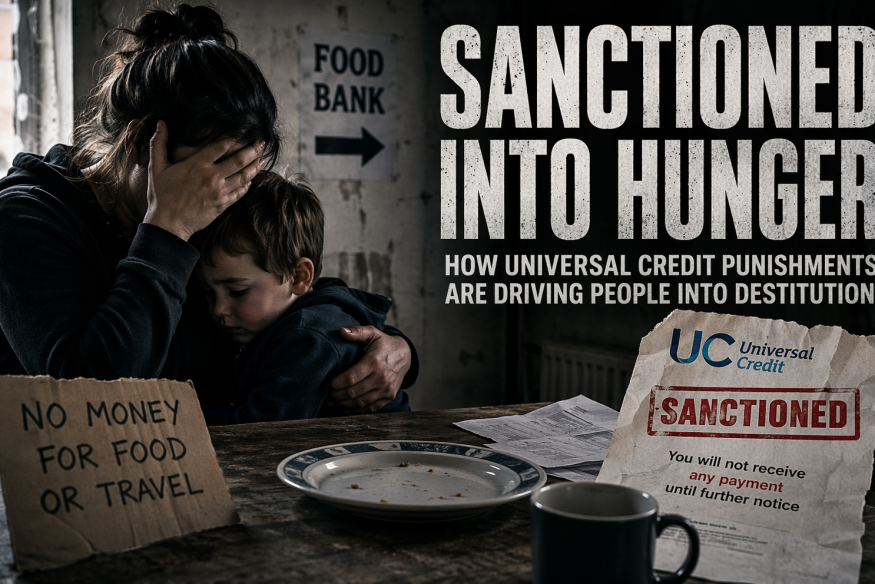
Sanctioned Into Hunger: How Universal Credit Punishments Are Driving People Into Destitution

A
cross the UK, a growing body of evidence is exposing a stark reality: the Universal Credit sanctions regime is not simply a system of enforcement, but one that is pushing people into hunger, debt and deepening poverty. What is presented as a mechanism to encourage compliance increasingly appears to function as a form of punishment that removes the very means people need to survive.
According to the government's sanctions policy, the system allows the state to withdraw up to 100% of a claimant’s standard allowance. In practice, this can mean that a person suddenly has little or no money for food, heating or transport. The loss is not often gradual; it's immediate, and for many, devastating. Research and case evidence reveal that sanctions are often applied for missed Jobcentre appointments, yet this is where the system reveals one of its most troubling contradictions. People are frequently sanctioned because they cannot afford to attend. When income is removed, the cost of transport, phone credit or internet access becomes prohibitive for receiving critical appointments at the Jobcentre. Missing an appointment then leads to further sanctions, creating a cycle that is difficult, and often impossible, to escape.
Advertisement
 Shop: Ecoflow Whole Home Power Supply Units from Amazon.com
This dynamic has been described by advice organisations as a “sanctions spiral”, in which the penalty itself prevents compliance with the conditions required to end it. Individuals find themselves trapped in a system that demands engagement while simultaneously removing the resources necessary to participate. The result is not behavioural correction, but escalating hardship.
Evidence from charities and policy groups consistently shows a disproportionate system where sanctioned claimants are often left with no money at all. Many are forced to rely on food banks, informal borrowing or going without basic necessities altogether. Reports indicate that a significant proportion of people receiving Universal Credit have experienced running out of food within a matter of weeks. Far from acting as a safety net, the system is increasingly associated with acute financial crisis.
Advertisement

In theory, hardship payments exist to provide support during sanctions. In reality, they often deepen the problem. These payments are not grants but loans, recoverable from future benefits. Claimants must first demonstrate that they are unable to meet their most basic needs, effectively requiring proof of extreme deprivation before help is granted. Even when approved, the repayments reduce future income, extending financial strain well beyond the sanction period itself. What is presented as emergency assistance can therefore lock individuals into a longer-term cycle of reduced income and debt.
The scale of the issue remains substantial, with tens of thousands of sanctions issued in recent periods. A 2025 report by Policy in practice, supported by Lloyds Bank Foundation highlights “increase poverty and impact the ability to afford basic living costs” At the same time, criticism from charities, researchers and advocacy groups continues to intensify. Concerns have been raised about fairness, proportionality and the unequal impact on certain groups. The overarching pattern that emerges is one in which hardship is not an unintended side effect, but a predictable outcome of how the system operates.
Advertisement
 Shop: Ecoflow Whole Home Power Supply Units from Amazon.com
Evidence also suggests that sanctions are not always applied in an proportionate or consistent manner. Individuals have been penalised in circumstances involving illness, caring responsibilities or administrative misunderstandings. There are repeated accounts of decisions being made in ways that presume non-compliance rather than investigating context. Studies indicate that most sanctions arise not from a refusal to work, but from missed procedural requirements, raising serious questions about whether the system is targeting the right behaviours at all.
Advertisement

The human impact extends beyond immediate financial hardship. The loss of income and the uncertainty surrounding sanctions are linked to worsening mental health, increased stress and social isolation, increasing the difficulty of getting back into work. Financial instability can quickly cascade into housing insecurity and long-term debt, eroding not only material wellbeing but also personal dignity. Reports show that a large proportion of claimants in debt have gone without food, while many run out of money before their next payment is due. These are not isolated cases but indicators of systemic strain.
Advertisement

Perhaps most concerning is the growing evidence that sanctions may not achieve their stated objective. Rather than supporting people into employment, the removal of income can make job searching significantly more difficult. Without money for transport, appropriate clothing or digital access, the ability to seek and secure work is undermined. Some research suggests that sanctions may push individuals into unstable or low-paid work, or disengage them from the system entirely. In this sense, the policy risks being not only harmful, but counterproductive.
Advertisement

Evidence from multiple independent reports presents a deeply troubling picture. Universal Credit sanctions have the power to remove all income, restrict access to basic necessities and prevent compliance with the very conditions they are meant to enforce. They can drive reliance on emergency food aid, deepen cycles of debt and contribute to deteriorating health and wellbeing. What is framed as a system of accountability increasingly resembles one of deprivation.
This raises a fundamental and uncomfortable question. When a policy requires people to prove their hardship while simultaneously stripping away the means to avoid it, can it still be described as a safety net, or has it become something else entirely?
JamRadio may earn a commission if you purchase products advertised on our website at no extra cost to you.
Follow JamRadio for updates: