July 10, 2026 - 2928 views
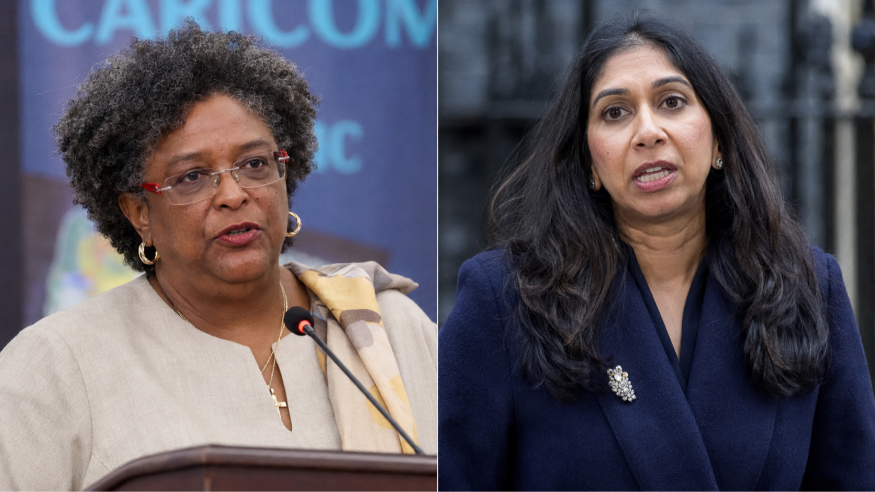
The Barbados Prime Minister delivered a blunt response after former British Home Secretary Suella Braverman suggested that former colonies should compensate Britain for its contribution to their development.

CASTRIES, Saint Lucia: Barbados Prime Minister Mia Amor Mottley has sharply rejected remarks by former British Home Secretary Suella Braverman suggesting that former colonies should pay Britain for the “investment, effort and contribution” made during the colonial period.
Mottley was responding to a question during the closing press conference of the 51st Regular Meeting of the Conference of Heads of Government of CARICOM in Saint Lucia.
Although Mottley did not call Braverman by name during her answer, the question followed the British politician’s intervention in the increasingly heated debate over Caribbean demands for reparatory justice.
In 2026, I cannot believe we are being asked to respond to the suggestion that the descendants of the enslaved should pay for the machinery that oppressed them.
— Mia Amor Mottley (@miaamormottley) July 9, 2026
The Caribbean does not owe Britain for slavery, for colonial extraction, or for laws that treated African people as… pic.twitter.com/xgLKwXrZzo
“I’m not sure that you want me to reply to things that really are asinine,” Mottley began.
She then addressed the substance of Braverman’s argument directly.
“And certainly the notion that we should pay the United Kingdom for oppressing us, for enslaving us and for treating us as chattel.”
Advertisement

What Braverman said
Braverman, who served as Home Secretary under former prime ministers Liz Truss and Rishi Sunak before later joining Reform UK, made the remarks after Labour MP Bell Ribeiro-Addy highlighted Jamaica’s plan to take its reparations case directly to King Charles III.
The Jamaican government intends to petition the King on 6 September and ask him to refer important legal questions concerning slavery and reparations to the Judicial Committee of the Privy Council.
Responding on social media, Braverman acknowledged that slavery was “abhorrent” but argued that present-day British citizens should not be required to pay for actions committed centuries ago.
She went further, suggesting that the financial argument should be turned against Britain’s former colonies.
“If the government is seriously thinking about this, then former colonies should pay the British back for the considerable investment, effort and contribution that this country made, which laid the foundations for many flourishing democracies today,” Braverman wrote in her original statement.
Advertisement

The remarks presented British colonialism as an investment for which former colonies should now be grateful, largely setting aside the wealth extracted through slavery, forced labour, land dispossession and centuries of unequal colonial trade.
“We are not asking for charity”
Mottley rejected that reading of history.
She pointed to the 1661 Barbados Slave Code, one of the earliest comprehensive legal frameworks governing racial slavery in the English Caribbean. The code became a model for other slave laws across Britain’s colonies and established the treatment of enslaved Africans as property.
Mottley also referenced France’s Code Noir, which similarly regulated slavery in French colonies and legally classified enslaved people as property. France’s National Assembly only voted to formally repeal the centuries-old code in May 2026.
“We’re not asking for charity,” Mottley said. “We’re asking to be able to ensure that justice can be done.”
She reminded those listening that when slavery was abolished across much of the British Empire, the British Parliament accepted that compensation was necessary. However, the money did not go to those who had been enslaved.
Britain borrowed £20 million to compensate slave owners for the loss of what the law had regarded as their “property”. The enslaved received nothing and were instead subjected to a further period of forced labour under the apprenticeship system.
Advertisement

“In 1834, the British Parliament did not need to be persuaded of that fact with respect to the loss of property, because we were chattel, and the compensation of the enslavers of £20 million,” Mottley said.
She advised British politicians commenting on the matter to first acquaint themselves with the historical record.
“I would like to advise that those who have not yet read sufficiently to understand the history do so before making comments that really do not reflect well on them.”
Caribbean will not be used as a political prop
Mottley placed the exchange within a broader international movement for reparatory justice.
She pointed to the growing cooperation between CARICOM and the African Union, the recent reparations conference in Accra, Ghana, the United Nations resolution on the transatlantic trafficking of enslaved Africans, comments from Pope Leo XIV and French President Emmanuel Macron, and previous remarks by King Charles that reparations had become a conversation whose time had come.
Advertisement
Her response also appeared aimed at Reform UK’s wider attempt to turn reparations into an immigration issue.
In April, Reform UK proposed blocking visa applications from countries formally seeking slavery reparations from Britain. The proposal was condemned by the CARICOM Reparations Commission as an attempt to punish countries and people seeking justice. Reuters reported that the proposed restrictions could affect countries including Jamaica and Ghana.
Mottley suggested that attacks on the Caribbean’s reparations campaign were being used to serve political interests inside Britain.
“I have no doubt that there are British parliamentarians who want to distract people from the domestic politics of the United Kingdom at this point in time,” she said.
“But the Caribbean should not be used as a prop in those circumstances.”
Braverman attempted to turn the reparations argument on its head by presenting colonial rule as a debt owed to Britain. Mottley’s answer was equally direct: a region built through enslavement, extraction and the legal treatment of human beings as property will not be asked to compensate the power responsible for imposing that system.
The Caribbean, she made clear, is not demanding charity from Britain. It is demanding that Britain confront the historical record.