January 03, 2026 - 2287 views
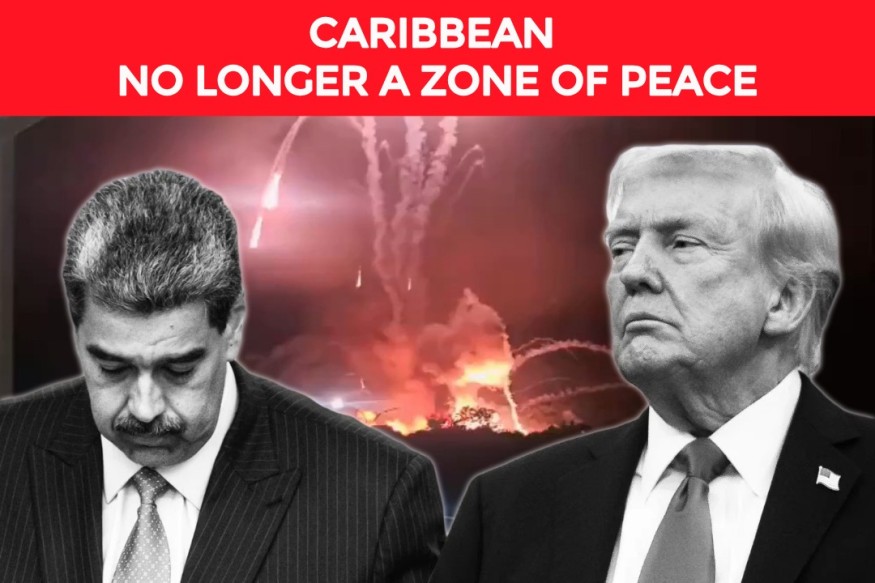
The Caribbean is no longer a Zone of Peace as U.S. President Trump orders Airstrikes on Venezuela

The Caribbean — long regarded as one of the world’s most stable and peaceful regions, is now facing its most serious military escalation in decades, after the United States launched direct strikes on targets inside Venezuela over night. The move marks a dramatic intensification of Washington’s confrontation with the Maduro government and signals a new, volatile chapter for the hemisphere.
✈️ BREAKING: The United States has launched aerial strikes on targets inside Venezuela, marking a major escalation in tensions between Washington and the Maduro government. U.S. officials say military facilities were hit as part of an ongoing campaign in the region#Venezuela… pic.twitter.com/iZ4zyCSZF1
— Jam Radio UK News (@Jam_RadioUK) January 3, 2026
U.S. officials confirmed that President Donald Trump authorised strikes on Venezuelan military facilities as part of what the administration describes as an expanded campaign against drug‑trafficking networks operating in the region. The attacks follow months of U.S. naval and air build‑up across the Southern Caribbean, including the deployment of major warships and surveillance aircraft positioned off Venezuela’s coast.
Explosions were reported across Caracas early Saturday, with eyewitnesses describing low‑flying aircraft, smoke rising from military installations, and widespread power outages near major bases. Venezuela has declared a national state of emergency, accusing the United States of attacking both civilian and military sites across multiple states.
— Pete Hegseth (@PeteHegseth) January 3, 2026
The strikes represent the first confirmed U.S. attacks on land‑based targets in Venezuela, following earlier operations against vessels alleged to be carrying narcotics in the Caribbean and Eastern Pacific. According to U.S. defence sources, a major coastal facility was destroyed in a drone strike, which Washington claims was used by criminal groups for drug distribution.
At the United Nations, senior officials warned that the situation is deteriorating rapidly. They noted that U.S. military operations off Venezuela’s coast have expanded significantly, heightening fears of a wider conflict and raising concerns about civilian harm and violations of sovereignty.
Regional governments have expressed alarm, urging restraint and adherence to international law as tensions escalate between two of the hemisphere’s most powerful adversaries.
President Nicolás Maduro has accused Washington of launching an illegal attack that threatens not only Venezuela but the entire Caribbean basin. In a message circulated to regional leaders, Maduro warned that the U.S. has ordered one of the largest naval and air deployments in the Caribbean Sea in decades, calling it a direct threat of force and a violation of international norms.
Venezuelan officials insist the country has committed no act that justifies such military intimidation, accusing the U.S. of manufacturing a pretext for intervention.
For Caribbean nations — many of which maintain close ties with both Washington and Caracas — the escalation is deeply unsettling. The region has historically prided itself on diplomacy, neutrality, and peaceful coexistence. But the sudden militarisation of Caribbean waters, combined with active U.S. strikes, has shattered that sense of security.
Analysts warn that the Caribbean is now at risk of becoming a frontline in a geopolitical struggle far beyond its making. The presence of U.S. warships, surveillance aircraft, and now confirmed airstrikes has raised fears of miscalculation, spillover violence, and humanitarian fallout.
Experts remain divided. Some argue the U.S. is applying calibrated pressure designed to fracture the Venezuelan military and force political change without a full‑scale invasion. Others warn that the combination of airstrikes, naval deployments, and political hostility could spiral into a broader conflict.
What is clear is that the Caribbean — once a symbol of calm seas and diplomatic balance — is now facing a moment of profound uncertainty.
As explosions echo over Caracas and U.S. aircraft patrol the skies, Caribbean leaders and citizens alike are left to grapple with a new reality: the region is no longer insulated from great‑power confrontation.
The question now is whether diplomacy can pull the hemisphere back from the brink — or whether the Caribbean will be forced to navigate the most dangerous geopolitical storm it has seen in generations.